
What is Sentiment Analysis and How Does it Boost Satisfaction?

Share
Do you ever wish you could get into your users’ minds and know what they really think and feel about your brand?
That's exactly what motivates sentiment analysis: the desire to understand user thoughts and feelings about a business. ✨
A recent study revealed that the market size of Sentiment Analysis Software is predicted to reach $11.4 billion by 2026 globally, with a compound annual growth rate (CAGR) of 22.4% from 2021 to 2026. This growth indicates the evolving need to investigate users’ sentiments.
While we’re facing information overload, businesses and organizations are presented with a huge amount of data generated by consumers across various platforms, which contains valuable insights into customer opinions, emotions, and perceptions.
To enhance customer experience, sentiment analysis has emerged as a powerful tool for measuring public sentiment and understanding customer satisfaction.
In this article, you’ll get to know what sentiment analysis is and its crucial role in satisfaction analysis.
Figure 1: Customer reviews and ratings reflect real user sentiment
What is Sentiment Analysis?
Sentiment analysis, also known as opinion mining, is a natural language processing (NLP) technique that involves extracting subjective information from text or speech data and classifying it into different sentiment categories such as:
- Positive 👍
- Negative 👎
- Neutral 😐
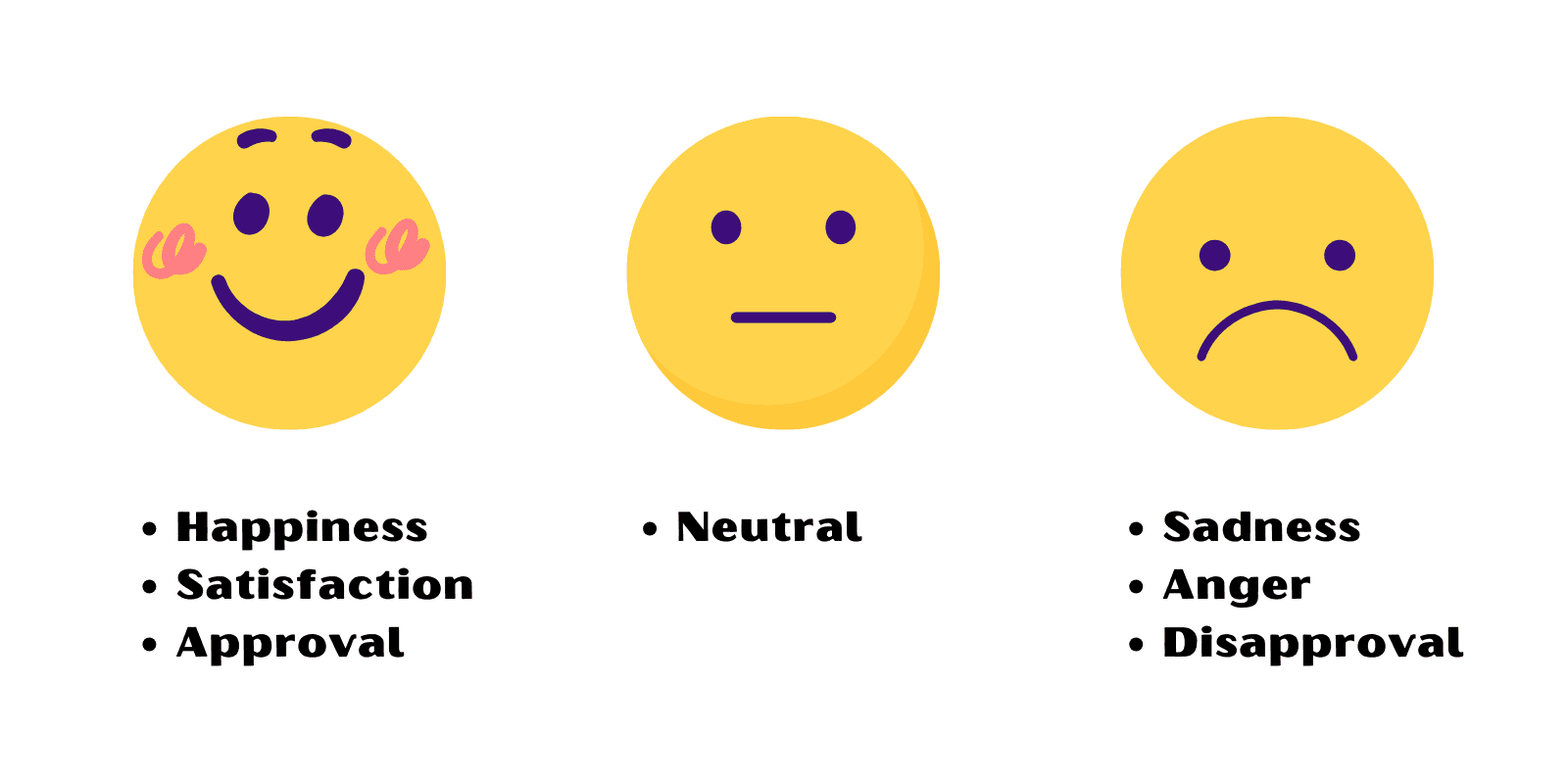
Figure 2: Emotions behind each sentiment category
Natural Language Processing (NLP) enables computers to understand the emotional tone behind a piece of text, whether it's a tweet, a review, a blog post, or a customer comment. NLP is a computer science field that combines linguistics and AI techniques, enabling machines to understand and extract insights from human language. After collecting data from various sources, machines are trained to mimic people behavior.
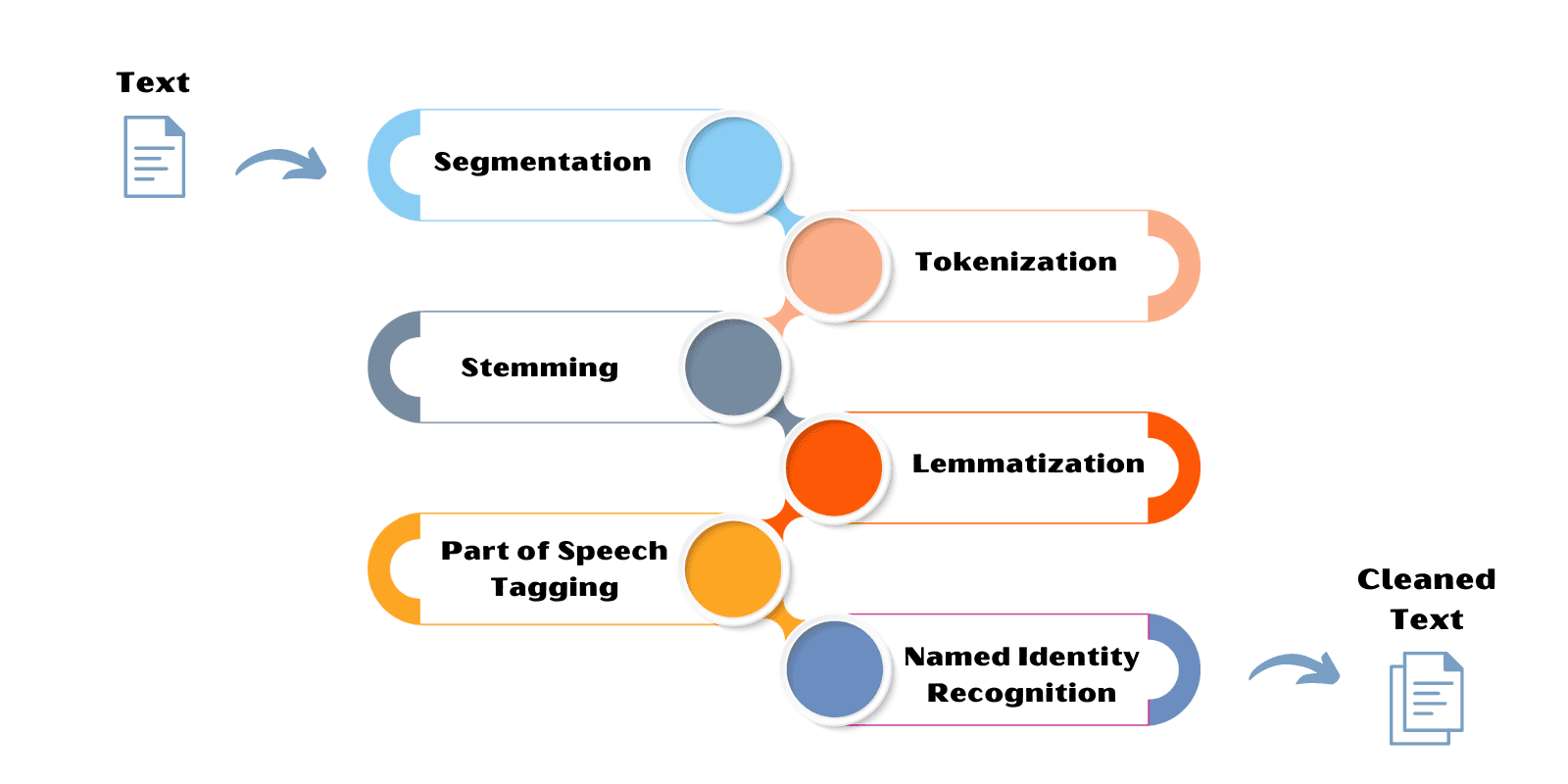
Figure 3: NLP Pipeline
You might be wondering about these terms! Allow me to explain each term of the NLP Pipeline in the simplest way possible:
-
Segmentation: It consists of dividing the text into relevant units such as sentences or paragraphs to facilitate its organization and analysis.
- Original Sentence: "The player played exceptionally well, and the team won the match."
- Segmented into Sentences:
"The player played exceptionally well."
"And the team won the match."
-
Tokenization: Tokens are words, symbols, characters, or any other meaningful element. Tokenization is then splitting segments to even smaller units to make it easier for machines to analyze each element separately.
- Original Sentence: "The player played exceptionally well, and the team won the match."
- Tokenized Words: "The", "player", "played", "exceptionally", "well", ",", "and", "the", "team", "won", "the", "match", "."
-
Stemming: It reduces the word to its core form. For example, "played," "playing," and "player" would all be reduced to "play".
-
Lemmatization: It resembles stemming as it involves reducing the word to its base or root form, too. While in this case, "played" and "playing" would both be transformed to "play," but "player" might be identified as "play" or "players" depending on the sentence. Thus, lemmatization preserves more meaning than stemming.
-
Part of Speech Tagging: It indicates assigning grammatical categories to each word (noun/verb/adjective…) to help machines understand the word’s function within the sentence, giving it more context for analysis.
- Original Sentence: "He plays the guitar, and she plays the piano."
- POS Tagged Words: "He" (pronoun), "plays" (verb), "the" (article), "guitar" (noun), "," (punctuation), "and" (conjunction), "she" (pronoun), "plays" (verb), "the" (article), "piano" (noun), "." (punctuation)
-
Named Entity Recognition: It consists of identifying and classifying named entities including names of people, dates, locations,... This helps machines to extract relationships and provide insights from the text.
- Original Sentence: "He plays the guitar, and she plays the piano."
- Named Entities Identified: "He" (Person), "the guitar" (Instrument), "she" (Person), "the piano" (Instrument)
What are the main steps of sentiment analysis?
At its core, sentiment analysis involves the following steps:
-
Text Data Collection:
Gathering textual data from various sources, including social media platforms, online reviews, surveys, and customer feedback.
For social media, machines extract content from posts, comments, and even messages. They also collect users’ reviews from various websites such as Amazon and Google Reviews. Forms are a great tool to get qualitative data through open-ended questions, too. Those different methods enable machines to get a holistic overview about users’ feedback and impressions. -
Text Preprocessing:
This consists of cleaning and preparing the text data by removing noise, punctuation, special characters, and stopwords. This step is crucial to ensure accurate sentiment analysis results.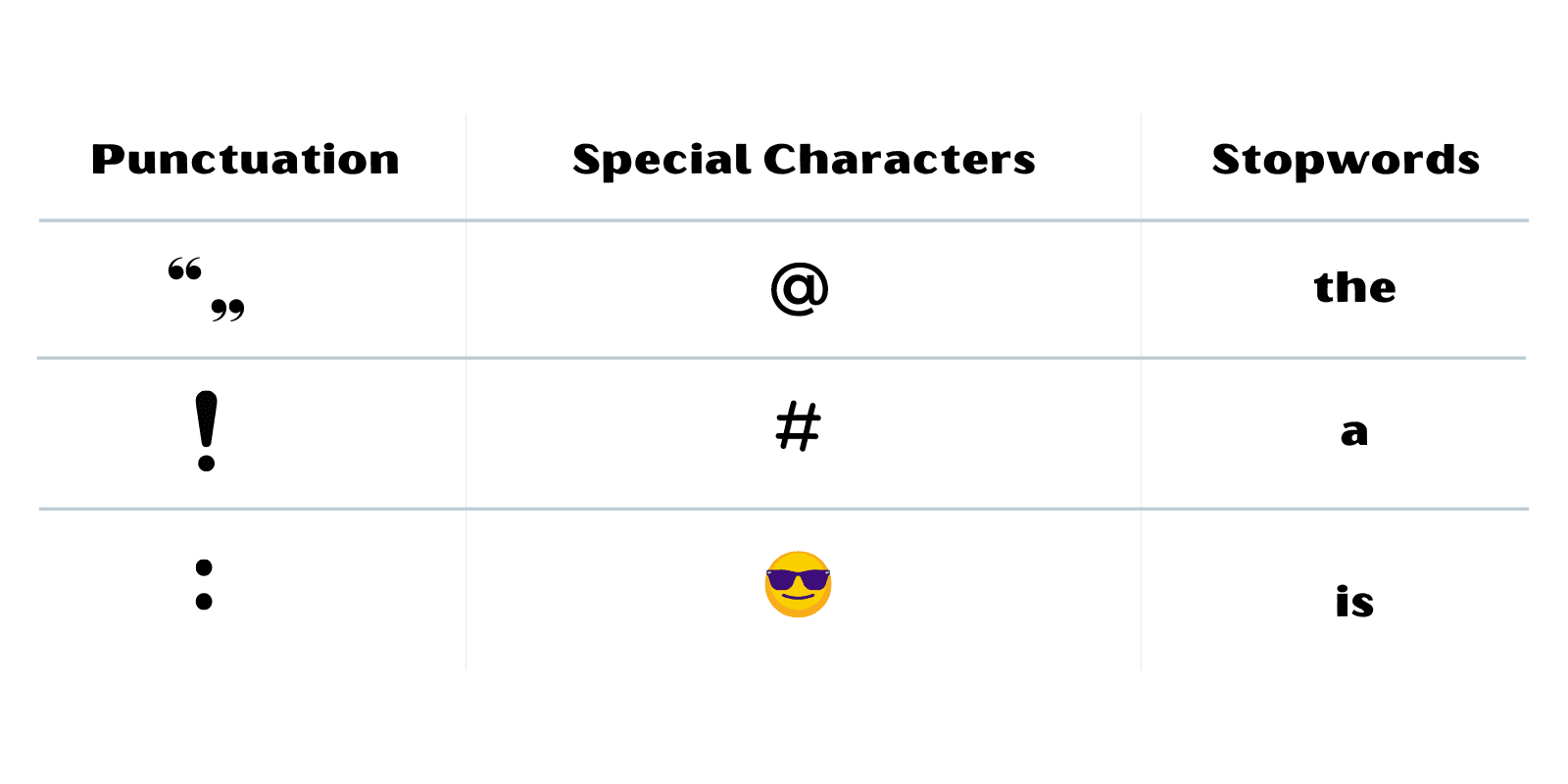
Figure 4: Types of Noise
-
Sentiment Classification:
The text is classified into different sentiment categories, such as positive, negative, or neutral, using machine learning algorithms and linguistic analysis.
Some of the machine learning algorithms that are used on sentiment classification are Naive Bayes, Logistic Regression, Support Vector Machines (SVM), Recurrent Neural Networks (RNN), and Deep Neural Networks (DNN). The Table below summarizes what are the pros and cons of each algorithm.Algorithm Pros Cons Naive Bayes - Simple and easy to implement
- Effective for text classification tasks
- May not perform well with small datasets
- Assumes that features are independent which may not be true in real-world scenarios
Logistic Regression - Efficient for large datasets
- Effective for binary classification tasks
- May not perform well with non-linear relationships
SVM - Suitable for datasets with a high number of features.
- Effective in preventing overfitting
- May not perform well with large datasets
RNN - Can handle sequence data, such as text
- Can be used for both classification and generation tasks
- Requires large amounts of data for training
DNN - Can handle complex tasks, such as image and speech recognition
- Requires large amounts of data for training
-Pros and Cons of Different Machine Learning Algorithms- To sum-up, the choice of the algorithm depends on the nature of your problem, the size and the complexity of your data, and your available resources.
-
Sentiment Analysis Output:
The output of sentiment analysis is generally presented as a sentiment score or a sentiment label, indicating the overall sentiment expressed in the text.
A sentiment score is a numerical value that computes the intensity degree of a particular sentiment and this score could range from 0 to 1, while a sentiment label is a categorical variable that splits the sentiments into categories such as positive, negative, and neutral.
How can businesses benefit from sentiment analysis?
Customer Insights and Satisfaction Enhancement:
Sentiment analysis help businesses in customer feedback analysis in 3 aspects:
- Identifying Pain Points
- Understanding Preferences
- Personalization
Companies can easily investigate their customers’ impressions towards its products and services, allowing them to address customers’ complaints quickly and effectively. They can also identify what went well with previous products and services to keep those features in future offerings. Hence, it’s essential for businesses to tailor their offerings according to users’ perceptions and emotions. Work smart! 😉
Brand Management and Marketing:
In marketing, it is crucial to track the effectiveness of your marketing efforts.
Sentiment analysis helps you assess people’s reaction towards different campaigns.
Taking the example of Influencer Marketing, companies should well identify influencers who are positively associated with the brand and those who align with the business’s values to ensure a good impact.

Figure 5: Influencer marketing and audience sentiment
Product Development and Innovation:
Beta testing is a great asset to analyze users’ feedback while testing products that are still in the development phase. Before a wider release, it is considered very useful to focus on features that are most appreciated by the users or to design new features inspired by users’ preferences. Remember that you are building a product for users, so it’s essential to listen carefully to their concerns if you’d like to increase the likelihood of your product's success.
Competitive Intelligence:
When it comes to understanding your competitors' audience, nothing beats sentiment analysis. Benchmarking with sentiment analysis reveals your competitors’ strengths and weaknesses, allowing you to keep track of industry trends.
Let’s take the example of a political campaign, where sentiment analysis helps in understanding public opinions about candidates. This analysis can later help in crafting the campaign strategy, setting policy decisions, and preparing for crisis management.
However, we can’t deny that sentiment analysis may encounter several challenges. One of the most common issues is the nuanced nature of human language. People often express emotions using sarcasm, irony, or culturally specific idioms that can be challenging for automated algorithms to interpret accurately. Context plays an important role in determining sentiment, and the same words can carry varying emotional weight depending on the surrounding text. Another challenge is where certain words or phrases can have multiple meanings, leading to misclassification of sentiments. Addressing these challenges requires a combination of advanced machine learning techniques, linguistic expertise, and ongoing efforts to fine-tune models for better contextual understanding.
FAQs
Question: What are some popular tools for sentiment analysis?
Google Cloud Natural Language API, Amazon Comprehend, Microsoft Azure Text Analytics, Lexalytics Semantria,...
Question: What are some types of sentiment analysis?
Polarity-Based sentiment analysis, Fine-Grained, sentiment analysis, Aspect-Based sentiment analysis, Intent-Based sentiment analysis.
Sources:
- https://www.linkedin.com/pulse/sentiment-analysis-software-market-present-future-p2k0f/
- https://aws.amazon.com/what-is/nlp/
- https://aws.amazon.com/what-is/sentiment-analysis/
- https://youtube.com/watch?v=6I-Alfkr5K4
- https://itechindia.co/us/blog/which-of-the-3-algorithms-models-should-you-choose-for-sentiment-analysis-2/