Machine Learning: Types, Algorithms, and When to Use Them

Share
“Machine intelligence is the last invention that humanity will ever need to make.” - Nick Bostrom
It is said that Artificial Intelligence, particularly Machine Learning, is one of the greatest achievements of human beings. It is not necessarily supposed to replace humans, it is rather supposed to intensify our creativity and potential. But understanding machine learning can be a hard or even boring task, with a wide range of algorithms and methodologies to choose from.
So what is machine learning and how does it work?
Machine learning is a subcategory of artificial intelligence, consisting of developing computer algorithms that are able to self-improve using data over time. Just like we learn from our past experiences, machines learn from past data to be less dependent on humans’ instructions. Its main objective is not just to automate routine activities to increase efficiency but also to use given, large and complex, datasets to extract useful insights to businesses.
Here are some concepts that you should first know:
- Data can be images, text, speech, etc…
- Labeled data are inputs with corresponding desired outputs.
- Algorithms are a set of instructions that define how a model learns from data and makes predictions.
- Models are mathematical representations or algorithms, used to learn patterns or make predictions from data.
- Features are data characteristics that are used then in data classification
- Training is the process of exposing an ML algorithm to datasets in order to prepare it to make accurate predictions.
- Testing is the evaluation of the model using a separate dataset.
- Accuracy measures how well a model can correctly classify or predict the desired outcome.
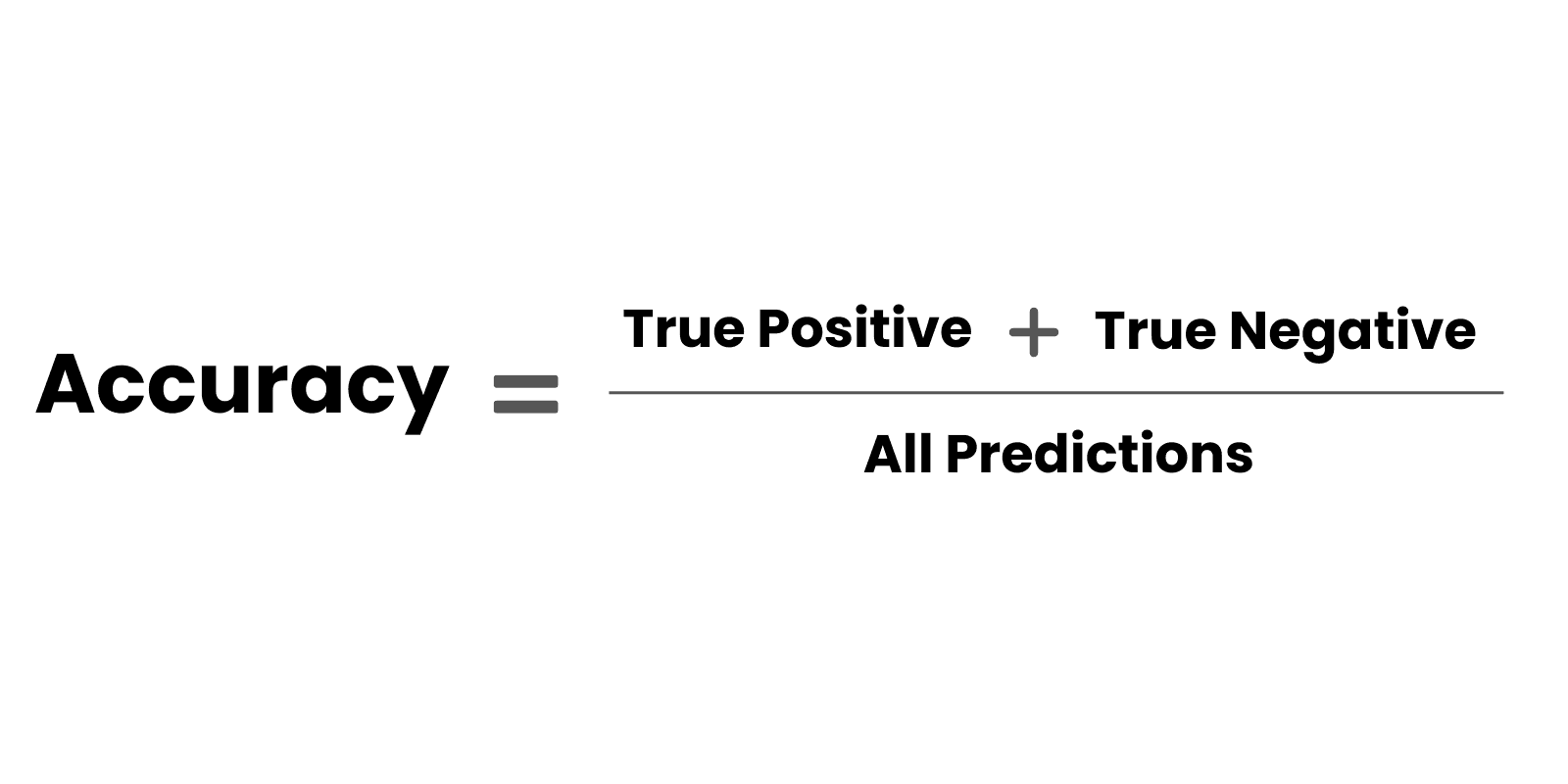
Figure 1: Accuracy formula
3 Types of Machine Learning :
Machine learning algorithms can be classified into three main types, where each type has its specific applications and methods.
Supervised Learning:
This type of algorithm learns from a labeled dataset, where the desired output is provided. The algorithm is trained to map input variables to the corresponding output. This type of learning is commonly used in tasks such as classification, regression, and forecasting.
Unsupervised Learning:
Unlike supervised learning, unsupervised learning algorithms work with unlabeled data. The goal is to find patterns, clusters, or relationships within the data without prior knowledge of the desired output. This type of learning is useful in data exploration, anomaly detection, and recommendation systems.
Reinforcement Learning:
This type of algorithm learns through trial and error. The algorithm interacts with an environment and learns to take actions that maximize rewards and minimize penalties. Reinforcement learning is often used in cases where there is no labeled dataset, such as learning to play games or control autonomous vehicles.
| Supervised Learning | Unsupervised Learning | |
|---|---|---|
| Data | Labeled data | Unlabeled data |
| Examples | Regression Classification | Clustering Association |
| Goals | Predict or classify new data based on labeled examples | Discover hidden patterns within the data |
| Data Requirements | Usually requires large datasets | Can perform with smaller datasets |
| Complexity | Simple | May be complex due to the lack of labeled data |
Most Used Machine Learning Methods :
Supervised Learning
Logistic Regression:
- Pros: It’s easy to understand and interpret, and works well for binary classification problems (like spam detection).
- Cons: It’s limited to linear relationships, and may not perform well for complex problems.
Support Vector Machines (SVMs):
- Pros: It’s effective for complex classifications and great for high-dimensional data.
- Cons: It can be computationally expensive and less interpretable than some other algorithms.
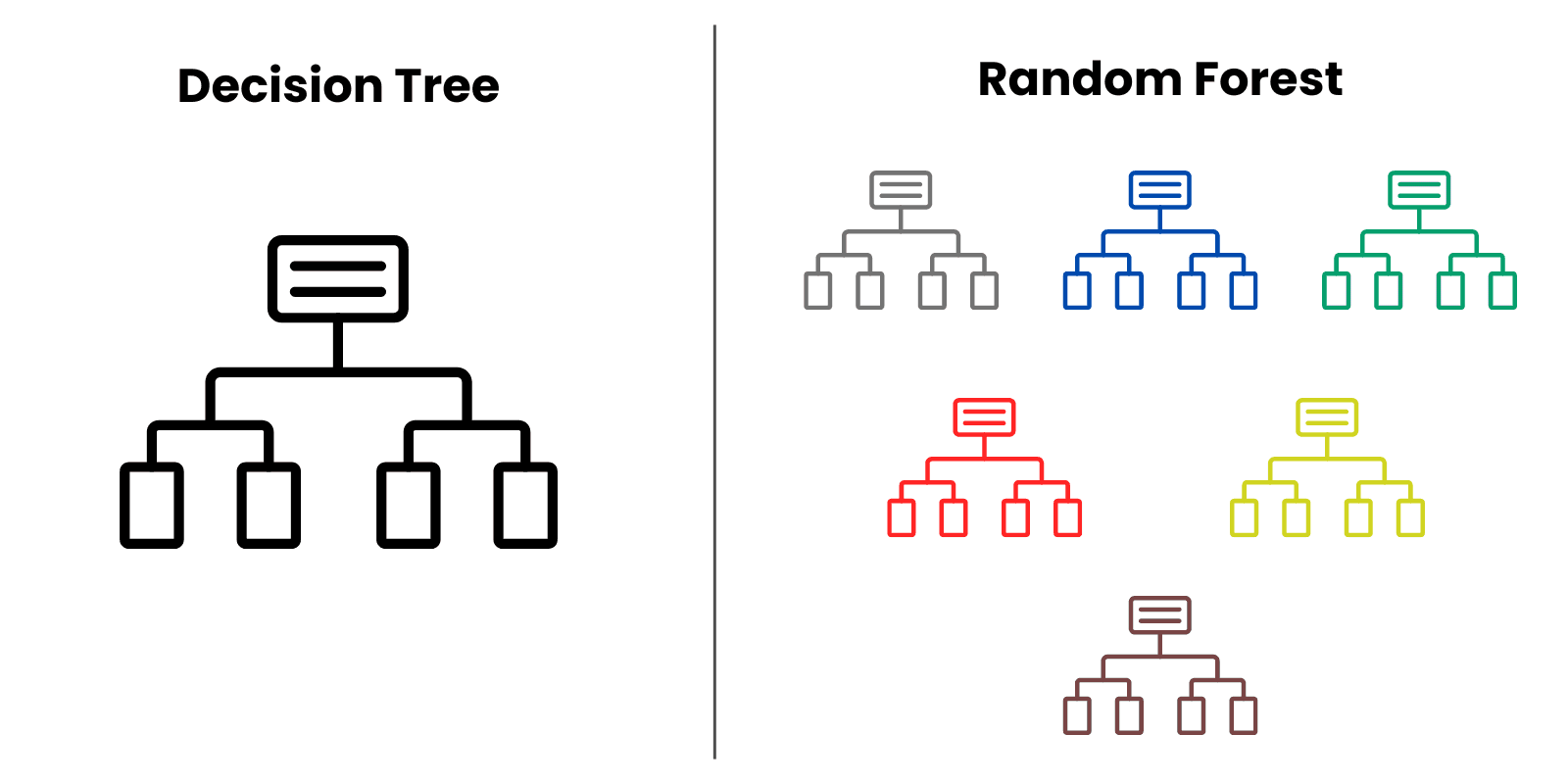
Decision Trees:
- Pros: Decision trees are easy to interpret, robust to outliers and can handle missing data well.
- Cons: It’s subject to overfitting and may not be as accurate as more complex models.
Random Forest:
- Pros: It combines multiple decision trees for improved accuracy and handles missing data well.
- Cons: It can be computationally expensive and less interpretable than individual decision trees.
Figure 2: Decision tree vs. random forest
Unsupervised Learning
K-Means Clustering:
- Pros: It’s simple and efficient for grouping similar data points.
- Cons: It requires pre-defining the number of clusters and it’s sensitive to outliers.
Principal Component Analysis (PCA):
- Pros: It’s very useful for visualization as it reduces data dimensions while preserving key information.
- Cons: It may lose some information because of reducing data dimensions.
Reinforcement Learning
Q-Learning:
- Pros: It’s suitable for dynamic environments as it’s a model-free approach.
- Cons: It can be slow to learn.
Deep Q-Learning:
- Pros: It uses deep neural networks for complex decision-making in dynamic environments.
- Cons: It’s very computationally expensive.
Real-Life Applications
Marketing and Business Intelligence
Machine learning algorithms are able to process huge amounts of data and extract hidden insights, giving businesses competitive advantage.
Machine learning algorithms including clustering and classification can be very helpful in 3 main aspects of the business: market research, customer segmentation, and targeting.
As machine learning can segment customers based on mutual characteristics such as demographics and lifestyle, and then it facilitates targeting potential clients to improve marketing campaigns and optimize marketing efforts, it can also predict future trends and variations in customer behavior.
Healthcare
Machine learning algorithms are becoming a great supporter for the medical team to enhance their healthcare interventions. Convolutional Neural Networks (CNNs) are for instance used to analyze X-rays and other medical images to detect illnesses like cancer with more accuracy. Machine learning can also detect the risk of developing some conditions or even help tailor treatment according to each patient’s health situation.

Figure 3: Analyzing X-rays for diagnosis
Recommendation Engines
From e-commerce websites to streaming services, recommendation systems are driven by ML algorithms to just facilitate our lives. The suggested products during our online purchase journey saves us time and a lot of effort. Those suggestions are not coming from nothing, they are the result of the analysis of our browsing history and behavior. Netflix and Spotify for example helps us discover new content according to our viewing habits and preferences.

Figure 4: Streaming platforms like Spotify use ML to power recommendations
Challenges Facing Machine Learning
There’s no denying the impact of machine learning in optimizing business operations. However, using large volumes of data and iterating between different algorithms can be complex. Here are some key challenges:
Data-Related Challenges
Data is essential to drive insights from machine learning algorithms, however it can be expensive to be acquired and takes a lot of time to be collected. The data should be of good quality to make good interpretations. This means that biases, inconsistencies, and outliers can ruin the accuracy of the models.
Another concern that terrifies users is the data privacy, which is the usage of their data that can be collected without their consent and which may include sensitive data.
Algorithm-Related Challenges
When data that is trained on is biased, the algorithm may inherit the same bias. Algorithms also need continuous improvement and maintenance so that it keeps the same performance.
Model-Related Challenges
You’ve probably heard about overfitting and underfitting the training data. Overfitting means that the model over-learns the details and noise in the training data to the extent that it fails to generalize to new data. On the contrary, underfitting is when the model is too basic that it doesn’t learn complex patterns effectively.
FAQs
What are neural networks?
Neural networks are a subfield of machine learning inspired by the structure of the human brain.
What’s the difference between machine learning (ML) and deep learning?
Both machine learning and deep learning are subfields of artificial intelligence (AI).
How do I know which algorithm to use?
You have to understand your problem and evaluate the size of your dataset and the complexity, strengths, and weaknesses of each model. You can try different algorithms and then evaluate which one suits you more. Don’t hesitate to seek expert’s help.
Is deep learning supervised or unsupervised learning?
Deep learning may be applied using various learning methods, including supervised and unsupervised. But the most common case is where deep learning models are trained on labeled data, a.k.a supervised learning.
What is the simplest machine learning algorithm?
Linear regression may be the simplest one. Other beginner-friendly algorithms are k-Nearest Neighbors (KNN) and decision trees.