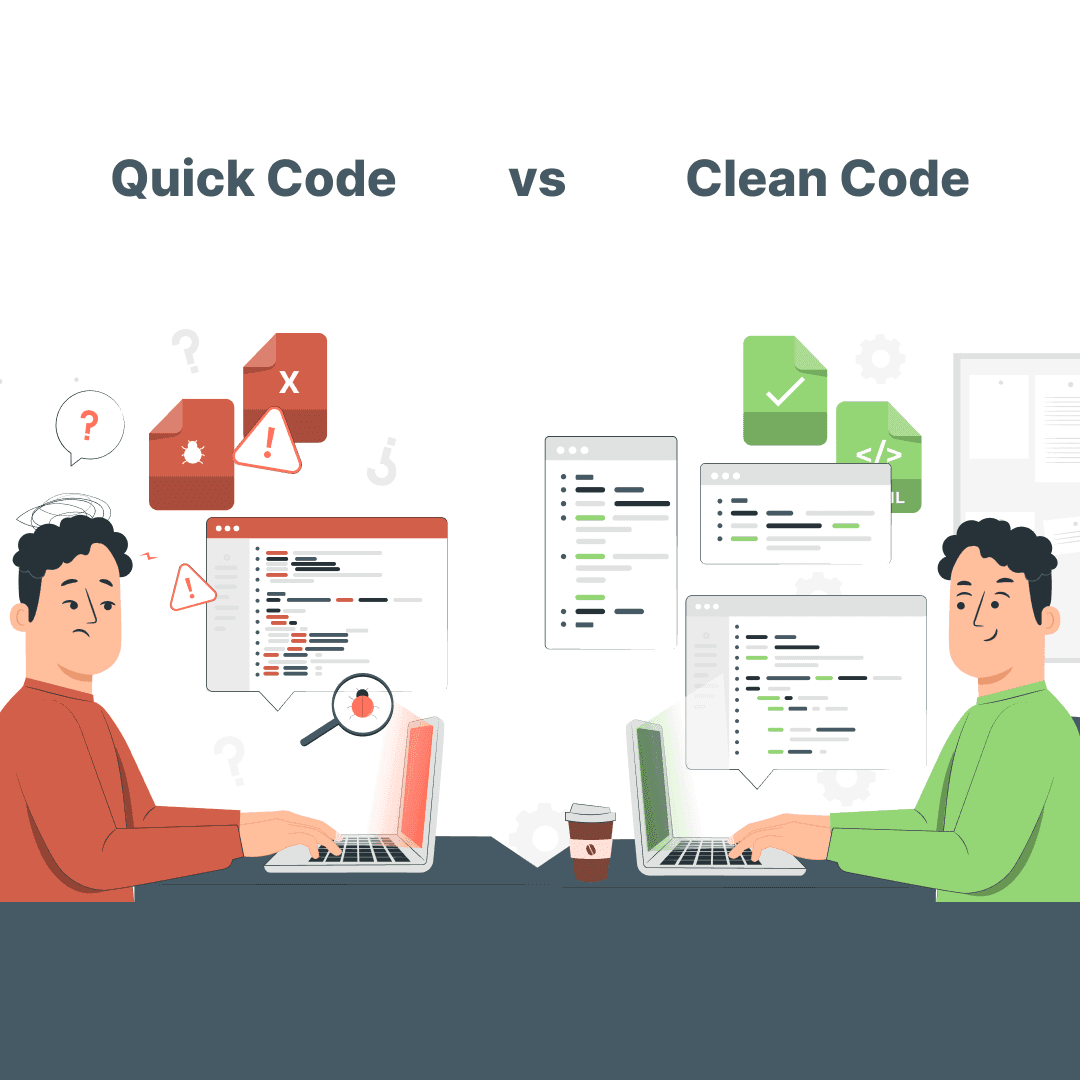
Clean Code VS Quick Code

Share
As a software developer, you often face the dilemma of choosing between writing clean, well-structured code or delivering a quick solution to meet deadlines. Both approaches have their merits and drawbacks, and finding the right balance is crucial for the success of your project.
Are you wondering how to strike the right balance? Then you’re in the right place!
Figure 1: Quick Code vs Clean Code
What is Clean Code?
Clean code refers to code that is easy to read, understand, and maintain. It's not just about making code look neat, it's about ensuring that the codebase is organized, well-documented, and free of redundancy.

Figure 2: Clean Code
Clean code follows principles such as:
 Readability
Code should be easy to read and comprehend. This means using meaningful variable names, clear structure, and avoiding complex and convoluted logic.
 Consistency
Following a consistent coding style and conventions helps in maintaining uniformity throughout the codebase, making it easier for team members to collaborate.
 Simplicity
The code should do only what it needs to do, nothing more. Simplicity involves breaking down complex problems into smaller, manageable chunks.
 Documentation
Proper comments and documentation are crucial. They provide context and explanations that help future developers (or even your future self) understand the code.
Why is it Important to Have a Clean Code?
While writing clean code might take slightly longer initially, it offers significant benefits in the long run, such as:
- Reduced Maintenance Costs
Clean code reduces maintenance costs because it's easier to understand and modify. This can save developers significant time and resources when fixing bugs or adding new features. Clean code typically adheres to best practices such as using meaningful variable names, writing modular functions, and maintaining proper documentation. These practices reduce the likelihood of introducing errors when changes are made. Furthermore, clean code often includes thorough test coverage, making it easier to identify and fix issues before they reach production. - Improved Team Collaboration
Consistent coding style and clear documentation facilitate better team collaboration. When code is written in a consistent style, it’s easier for different developers to understand and contribute to the same codebase. This is especially important in a team setting where multiple developers may work on the same project. Clear documentation helps new team members get up to speed quickly and ensures that everyone understands the design decisions and functionality of the code. This minimizes misunderstandings and errors, leading to more efficient and effective teamwork. - Enhanced Code Quality
Clean code leads to enhanced code quality, which is essential for creating stable and reliable applications. High-quality code is less prone to errors and security vulnerabilities, providing a better user experience. Developers following clean code principles typically write more modular and reusable code, making it easier to test and maintain. This results in fewer bugs and a more secure codebase. Additionally, clean code practices encourage thorough testing, which helps to catch and fix issues early in the development process. Enhanced code quality means that applications are more likely to meet user expectations and perform reliably under various conditions. - Better Developer Experience
Working with clean code provides a better developer experience. Clean code is more comfortable and enjoyable to work with, fostering a sense of ownership among developers. This can increase their productivity and motivation. When developers can easily understand and modify code, they are more likely to feel confident in their work and take pride in their contributions. This sense of ownership can lead to higher quality work and a more positive work environment. Additionally, a better developer experience can reduce turnover, as developers are more likely to stay with a project or company where they enjoy working with the codebase. Investing in clean code practices can lead to a more motivated and productive development team.
What is Quick Code?
Quick code, on the other hand, refers to code that is written to solve immediate problems or meet pressing deadlines. The focus is on speed and getting the job done as quickly as possible, often at the expense of code quality.
It may involve shortcuts, workarounds, and a disregard for best practices.

Figure 3: Quick Code
Quick code typically involves:
Time constraints often lead to minimal or no documentation, which can make the code harder to understand later.
To save time, developers might use shortcuts or workarounds that can significantly slow down development in the future.
Quick code may not adhere to coding standards and best practices, leading to potential issues in the long term.
What are the Challenges of a Quick Code?
-
Increased Maintenance Burden
Messy code is notoriously difficult to understand and modify, leading to longer debugging times and immense frustration for developers. When the code is poorly organized or lacks comments and proper documentation, developers spend a significant amount of time just trying to understand how it works before they can even begin to fix bugs or add new features. This inefficiency not only slows down the development process but also increases the likelihood of introducing new errors while attempting to fix existing ones. The result is a cycle of increasing complexity and difficulty, where each modification becomes more challenging and time consuming than the last. -
Technical Debt
Quick code often accumulates “technical debt”, a metaphorical concept that represents the future cost of additional rework due to taking shortcuts now. When developers prioritize speed over quality, they might skip writing tests, ignore best practices, or leave parts of the code unfinished. This technical debt means that the code will require significant effort to improve later. Over time, the accumulation of technical debt can slow down development as more and more time is spent dealing with the repercussions of earlier shortcuts. It can also lead to more frequent and severe issues, as the unstable foundation of the codebase becomes harder to manage and maintain. -
Reduced Code Reliability
Code quality issues often lead to bugs, crashes, and security vulnerabilities, significantly impacting the application's reliability.
Messy code is typically less tested and less modular. These issues can manifest in minor bugs that annoy users or even critical failures that can cause data loss or security breaches. Poorly written code is also harder to audit, increasing the risk of vulnerabilities being exploited. In a production environment, this can lead to downtime, data breaches, and a loss of user trust, which are costly and damaging to any organization. -
Lower Developer Morale
Working with poorly written code can be highly demotivating for developers. When developers are forced to spend their days dealing with confusing code, facing unexpected bugs, and struggling to implement new features, their job satisfaction can go down. This frustration may even cause burnout and higher turnover rates, aren’t developers seeking out positions where they can work with higher quality and more enjoyable codebases?! 🫣
Additionally, developers are less likely to experiment or propose improvements when they know they will be difficult to implement. Ultimately, maintaining high developer morale is crucial for a productive and innovative development team.
However, quick code can enable a more iterative development approach, where you can quickly build and deploy a minimum viable product (MVP), gather feedback, and then refine and improve the codebase over time. In some cases, delivering a working solution quickly is more important than creating a perfectly clean codebase.
But Could Quick Code be better than Clean Code in Some Cases?
Although clean code appears to be more efficient and professional, there are several scenarios where prioritizing quick code can be more beneficial.
- Proof-of-Concept Projects: When building prototypes or proof-of-concept projects to validate an idea or test a hypothesis, the goal is to get a working solution in front of users as quickly as possible. In these cases, writing clean, maintainable code is less important than delivering a functional product that demonstrates the core concept.
- Hackathons and Time-Constrained Events: Such events often reward teams that can build a working solution in a short period of time. Focusing on clean code practices can slow down development and prevent teams from meeting the tight deadlines. In this scenario, quick code that delivers the required functionality is more valuable.
- Experimental Features: For experimental features that may or may not make it into the final product, writing clean code is less important than getting the feature in front of users to test its viability. Quick code allows for faster experimentation, which can be more beneficial than a perfectly clean codebase.
Conclusion: Balancing is the Key
The ideal approach is to find a balance between clean code and quick code, depending on the specific requirements and constraints of your project.
For instance, you may identify the critical parts of your application that require clean, maintainable code, while for less critical sections, quick code can be acceptable if it helps meet deadlines.
It is crucial though to set clear coding standards for your team and encourage developers to follow them. You can also engage in pair programming, where two developers work together on the same code. This practice can help in balancing speed and quality, as one developer writes the code while the other reviews it.
FAQs
How do you balance between writing clean code and optimizing for speed?
Start with clean, readable code, and only optimize the specific areas that require it, while documenting the tradeoffs and maintaining a balance between the two priorities.
How can you identify performance bottlenecks in your code?
Use a combination of profiling, monitoring, testing, logging, and benchmarking to identify and analyze performance bottlenecks in your code. Start with profiling to pinpoint the problem areas, then dig deeper using the other techniques.